Determining Your Estimated Monthly Churn Rate
Last updated: August 5, 2025
In First Bite, assigning an estimated monthly churn rate during your product setup helps you forecast the expected lifetime value (LTV) of a deal for that product and understand potential revenue over time.
What Is Monthly Churn?
Monthly churn is the percent likelihood that an account will stop buying your product each month. It captures customer attrition and natural business closures. For example:
A 2% churn rate means that, on average, 2 out of every 100 customers may stop buying each month.
A churn rate below 1% is generally unrealistic, as restaurants naturally close at an average rate of ~1% per month. We recommend starting with a churn estimate between 2–4% unless you have historical data to support a different rate.
The table below gives you a comprehensive look at monthly churn rates to estimate how many months (or years) a customer might keep buying your product before they stop.
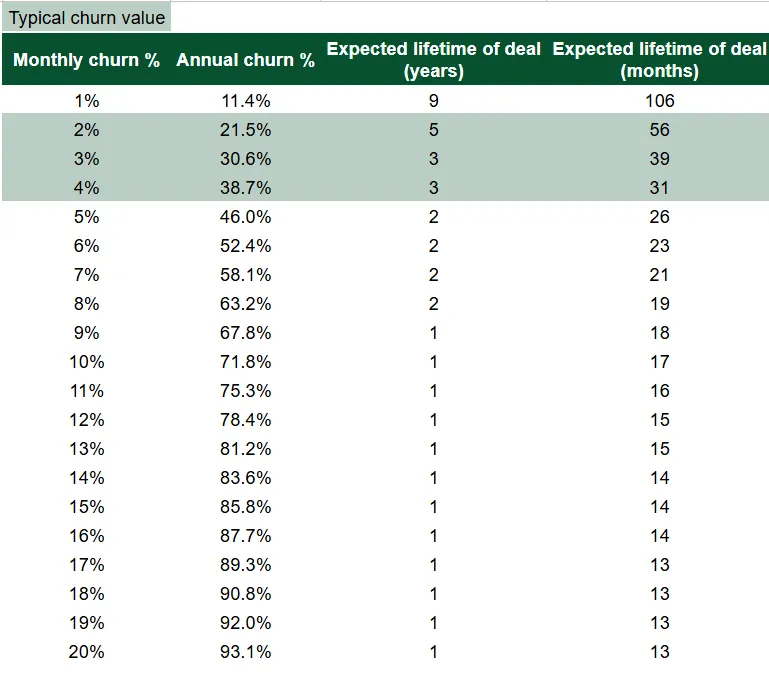
Monthly churn % = the chance a customer will stop buying each month
Annual churn % = the chance they’ll stop buying over a year
Expected lifetime of deal = how long they’ll keep buying (in years or months)
For Example…
If the monthly churn is 4%, that means 4 out of 100 customers stop buying each month.
On average, those customers will stick around for 31 months (or ~3 years).
If the monthly churn is 8%, they stop buying faster—so the average customer stays for about 2 years (or 19 months).
Why It Matters
Setting a churn rate helps First Bite calculate:
Annual churn (via compounding)
Expected revenue values over time
Expected lifetime of an account
Lifetime value (LTV) of your product
These calculations are key to accurate forecasting and sales planning.
Tips for Choosing a Churn Rate
If you're unsure, start with 2–4% as a general benchmark.
Use historical purchase data (if available) to refine your estimate over time.
Review and update your churn rate periodically as new data becomes available.